Metal Building Wall Panels
Metal building wall panels are the engineered steel skin of your building: the profiled panels that form the exterior wall, shed water and weather, and carry the look. Universal Steel manufactures and engineers wall panels into the steel buildings we design and build, from standard single-skin profiles to concealed-fastener and insulated systems, each custom-formed to your building and finished to match. Every panel is designed by our engineers and built to the nearest 1/16 of an inch, meeting or exceeding standard building codes.
Request a quote
A metal building’s wall panels are not a finish bought off a shelf and bolted on; they are part of the building’s structure and envelope. Universal Steel forms the wall panels, the trim and the fasteners alongside the frame and roof, so the whole envelope is engineered as one system. Panels are custom-cut to your building, the profiles and gauges are specified for your loads and span, and everything is fabricated under quality control in our manufacturing facilities.
Wall panels come in two broad choices. Single-skin panels are the steel cladding most metal buildings use: roll-formed sheets with ribs or a sculptured profile that add strength and a finished look. Insulated panels add a foam core for temperature control, covered in full on our insulated metal panels page. Within single-skin, the fastening sets the look: exposed-fastener panels are economical and straightforward, with color-matched screws through the face, while concealed-fastener panels hide the screws in the seams for a clean, architectural exterior.
Two things are worth knowing. Wide, flat metal can show oil canning, a slight waviness in large flat areas, so our panels use ribbed and sculptured profiles that resist it. And single-skin panels on their own do not provide a thermal break, so for a conditioned building we either add insulation behind the panels or step you up to insulated panels. We will tell you honestly which wall panel suits your building, your budget and how you will use it.
Our wall panel range
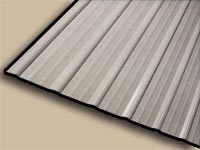
PBR (Purlin Bearing Rib)
Our most popular wall panel, with a clean, traditional appearance and real structural strength. The exposed, color-matched fasteners make it economical and straightforward to install, which is why it is the go-to for most steel buildings.
36" wide; 1¼" ribs; 26-gauge steel; 15 colors; color-matched fasteners
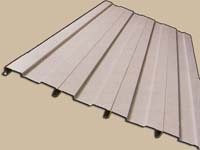
Concealed Fastener Wall System (CFW II)
For a sleek, contemporary exterior with no visible screws, the CFW II hides its fasteners in the seams. The embossed finish adds texture and durability, which makes it a favorite for architectural and front-of-building elevations.
16" wide, 3" deep; 1½" grooved contour; 22 or 24-gauge steel; 25+ colors; embossed finish
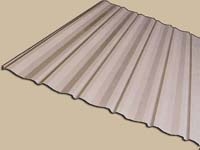
Shadow Panel
A strong balance of performance and affordability with an architectural touch. The 1" sculptured ribs conceal the fasteners for a cleaner look than a standard exposed-fastener panel, at a more accessible price than a fully concealed system.
36" wide; 1" sculptured ribs; 26-gauge steel; 15 colors; color-matched fasteners
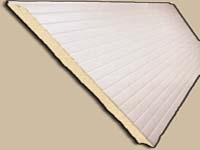
Sandwich Panel 300 (insulated)
Our insulated wall panel, a factory-assembled system that combines energy efficiency with a modern finish. It carries a continuous insulating core for conditioned and temperature-critical buildings. See our insulated metal panels page for the full insulated range and core options.
Factory-assembled insulated panel; continuous insulating core
Wall panels compared
The right panel depends on the look you want, the budget, and whether the building is conditioned. Here is how our wall panels compare. PBR, Shadow and CFW II are single-skin steel cladding; the Sandwich 300 adds an insulating core for temperature control.
| Panel | Profile & fastening | Best for |
|---|---|---|
| PBR | 36", 1¼" ribs, exposed fastener | Economical, traditional, most buildings |
| Shadow Panel | 36", 1" sculptured ribs, hidden fasteners | An architectural touch at an accessible price |
| Concealed Fastener (CFW II) | 16", concealed fastener, embossed | Sleek, modern, architectural elevations |
| Sandwich Panel 300 | Insulated core, factory-assembled | Conditioned and temperature-critical buildings |
R-values are industry-typical and vary by product and thickness; we specify the system to your building. Request an estimate.
Wall panel specifications
- Panel types
- PBR, Shadow, Concealed Fastener (CFW II), Sandwich 300 (insulated)
- Construction
- Single-skin steel and insulated
- Fastening
- Exposed (color-matched) or concealed
- Gauge
- 22, 24 or 26-gauge steel
- Material
- Galvalume or galvanized steel
- Widths
- 16 to 36 inches by profile
- Colors
- 15 to 25+ depending on the panel
- Finish
- Long-life coatings, 25 to 40 year finish warranty options
- Engineering
- Custom-formed to your building, to the nearest 1/16 inch, meets or exceeds standard codes
Metal Building Wall Panels questions
What is the difference between exposed and concealed fastener wall panels?
On an exposed-fastener panel, like our PBR, the screws are driven through the face of the panel and are visible, with color-matched heads. It is economical, simple to install and easy to maintain. On a concealed-fastener panel, like our CFW II, the screws are hidden in the seams, giving a smooth, unbroken exterior that is favored for architectural and front-of-building elevations. Our Shadow Panel sits in between, using sculptured ribs to conceal the fasteners at a more accessible price. Universal Steel will help you choose based on the look you want and your budget.
What gauge are steel wall panels?
It depends on the panel and the building. Our PBR and Shadow panels are standard 26-gauge steel, and the concealed-fastener CFW II is made from heavier 22 or 24-gauge steel. A lower gauge number means thicker steel. Because our in-house engineering team designs each building to your loads, span and exposure, we specify the gauge to suit your project rather than applying a single default.
Do metal wall panels have any drawbacks?
A couple are worth knowing. Wide, flat metal can show oil canning, a slight waviness in the flat areas, so our panels use ribbed and sculptured profiles that resist it. Thin-gauge panels can dent if handled roughly, which is why gauge is specified to the building. And a single-skin panel on its own does not provide a thermal break, so for a conditioned building we add insulation behind the panels or use insulated panels instead. Engineered and installed as part of the building, these are designed around rather than left to chance.
How long do metal wall panels last?
Steel wall panels are one of the most durable claddings available, carrying a Class A fire rating and standing up to extreme weather. The steel substrate and the long-life coating are what determine longevity, and the finish is backed by a 25 to 40 year finish warranty. Kept clean and undamaged, a quality steel wall panel system lasts for decades.
Can you get insulated wall panels?
Can you get insulated wall panels?
Get a quote for your building
We engineer panels, insulation and accessories into the building as one system, shipped from the closest plant.