Metal building maintenance is mostly two jobs: keeping water where it belongs, and catching small problems before they become big ones. For a pre-engineered metal building, that means a walk-around inspection at least twice a year, usually in spring and fall, more often on coastal, humid or corrosive sites, and again after any major storm or heavy snow. A steel frame that is kept dry and maintained is built to last the life of the building. What needs attention is everything that keeps weather out: drainage, roof and wall panels, trim, fasteners and the finish.
Start with the water
Water is the part of metal building maintenance that owners most often overlook. Owners think about the roof and walls, and forget to control where the water goes: runoff from the roof, water running off the land around the building, and the joints that keep the building watertight. Sound roofs and walls still let a building down if water runs toward it or pools at the base.
Overland flow is rainwater that runs across the ground rather than soaking in. On a sloping site, or where new paving sheds water toward the building, overland flow reaches the base of the walls in every heavy rain. Check that the ground still falls away from the building, that water isn’t pooling along the base trim, and that nothing paved or built since has changed where the water goes.
Gutters and downspouts are the other half of water control. Keep them clear, check joints and brackets, and make sure downspouts discharge away from the building. Drainage around the slab is part of the site and foundation design, so if water keeps collecting at the base, bring in whoever designed the site work.
How often to inspect a metal building
Metal building and panel makers’ maintenance manuals commonly recommend inspecting a building at least twice a year. Spring catches anything winter did, and fall leaves time for repairs before the next winter.
The Metal Construction Association’s study of metal roof service life makes the same case for roofs: a regular inspection program finds problems before they lead to localized corrosion, and on sites where leaves, pine straw and dirt collect, cleaning at least twice a year is prudent.
Some buildings need checking more often:
- Coastal sites, where salt air works on the finish and fasteners
- Humid or industrial areas, where moisture and airborne pollutants sit on the panels
- Buildings housing livestock, or processes that release moisture or chemicals inside
For coastal and livestock buildings, galvanized framing is an option at the design stage, though it doesn’t remove the need to inspect.
Local conditions set how hard a building works, and our state pages cover them in more detail: salt air in Puerto Rico, humid summers and storms in Georgia, heavy snow in Maine. Find your state on the coverage map.
Exterior: roof, walls, trim and fasteners
An exterior inspection of a metal building works from the top down. Check what you can from the ground or a lift, and leave walking the roof to someone trained and equipped for it.
- Roof: debris, standing water, and damaged or lifted panels
- Fasteners: loose, missing or backed-out screws on roof and wall panels
- Panels: dents, cracks, and scratches that go through the finish to the metal
- Laps, trim and flashing: gaps at panel laps, corners, the ridge and around roof penetrations such as vents and curbs
- Doors and openings: seals, weatherstripping, and doors that no longer open or close smoothly
A scratch that reaches the metal is worth touching up promptly with paint matched to the panel finish.
Cleaning the panels
Power washing the roof and wall panels is the simplest way to protect the paint finish. Dirt, mold and mildew left on the panels hold moisture against the paint. Plain water comes first. Heavier dirt usually comes off with a mild detergent and a soft brush, then a thorough rinse. Avoid wire brushes, abrasive pads and harsh solvents, and keep the pressure washer at a moderate setting with the nozzle well back from the panel. The panel and coating maker’s care instructions take priority, so check them before using any cleaner.
Inside: framing, insulation and moisture
Where the structural frame is shop-primed rather than galvanized, the primer is a shop coat, not a finish. The Metal Building Manufacturers Association’s Common Industry Practices (2024 edition, section 4.2.5) describes shop paint as intended to protect the framing “for only a short period of exposure to ordinary atmospheric conditions”, and notes that touching up minor abrasions is the owner’s responsibility. In practice, check exposed columns, rafters, purlins and girts for scratches and rust spots, and touch them up, particularly in humid or corrosive uses.
Inside, also look for water stains that point to a leak above, condensation on the underside of the roof, damaged or sagging insulation facing, and blocked vents. Condensation is mostly settled at design by the insulation system and ventilation. Maintenance keeps that system intact.
After a big storm or heavy snow
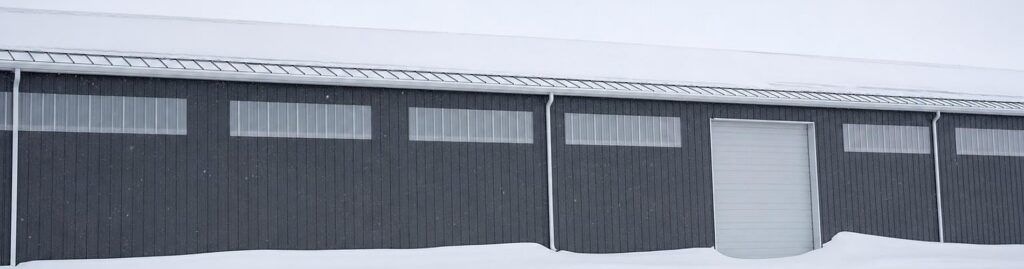
After a major storm or heavy snowfall, walk around the whole building and look for damage, not just on the side that faced the weather. After high winds, look for lifted or missing panels and trim, loose fasteners, damaged doors and debris on the roof. After heavy snow, check the walls as well as the roof. Snow that drifts or slides against a wall can push on the wall panels and bend them, which is why our engineers add lower girts to the walls of buildings in heavy snow areas.
FEMA’s Snow Load Safety Guide (FEMA P-957) lists the warning signs of a roof under strain during a snow event. They include sagging ceilings or sprinkler lines, popping or creaking noises, sagging roof panels, doors or windows that stop opening or closing, severe leaks, and water collecting where it shouldn’t on a low-slope roof. If any of these appear, FEMA’s advice is to get people out of the building and have a qualified design professional inspect it. Whether a metal building roof needs clearing at all is covered in how much snow a metal building roof can hold.
What to leave to the engineer
A pre-engineered metal building is designed for specific loads and specific openings. The frame, bracing, purlins and girts are sized for the wind, snow and other loads at that site, and for the building as drawn. Changes that alter those loads or that layout are design questions, not maintenance.
Check with the engineer who designed the building, or with the manufacturer, before:
- Adding weight to the roof, such as rooftop HVAC units, solar panels or hanging storage
- Hanging equipment from the frame, such as hoists, heaters or mezzanines that weren’t in the original design
- Cutting new openings in the walls or roof, or making an existing door wider
- Removing or moving bracing, including cable or rod bracing that looks as if it’s in the way
A larger door can change how wind acts on the whole building, as the guide to large doors and open walls explains. Bracing that looks redundant often carries wind and seismic loads to the foundation. Any visible bending, twisting or movement in the frame is also a question for an engineer, not a repair to attempt on site.
A metal building maintenance checklist
| When | What to check |
|---|---|
| Spring | Roof, panels, trim and fasteners after winter; gutters and downspouts; drainage at the base; interior for leaks and condensation damage |
| Fall | The same walk-around; clear gutters and roof of leaves; touch up scratches and rust spots before winter; check door seals |
| After a major storm | Panels, trim and fasteners; doors; debris on the roof; signs of water inside |
| After heavy snow | Roof warning signs; drifts against walls and bent wall panels; leaks as the snow melts |
| Once or twice a year | Wash roof and wall panels, more often on coastal or dusty sites |
Frequently asked questions
How often should a metal building be inspected?
A metal building should be inspected at least twice a year, usually in spring and fall, and again after any major storm or heavy snow. Coastal, humid, industrial and livestock buildings benefit from more frequent checks.
Does a metal building roof need to be cleared of snow?
Not as a routine job. A metal building engineered for its site’s snow load is designed to carry that snow. Uneven buildup is the exception. The snow load guide covers when clearing makes sense and how to do it safely.
How long does a metal building last?
A properly engineered and maintained steel frame is generally not what limits the life of a metal building. The parts that wear first are the ones regular maintenance looks after: fasteners, sealants, gutters and the finish.
Maintenance starts with the design
The easiest metal building to maintain is one that was engineered for its site from the start: the right loads, the right finish for its exposure, and drainage planned before the slab is poured. Our engineers design every building to the wind, snow and seismic loads where it will stand, with PE-stamped drawings for the local building department. To talk through a building for your site, request a quote.